
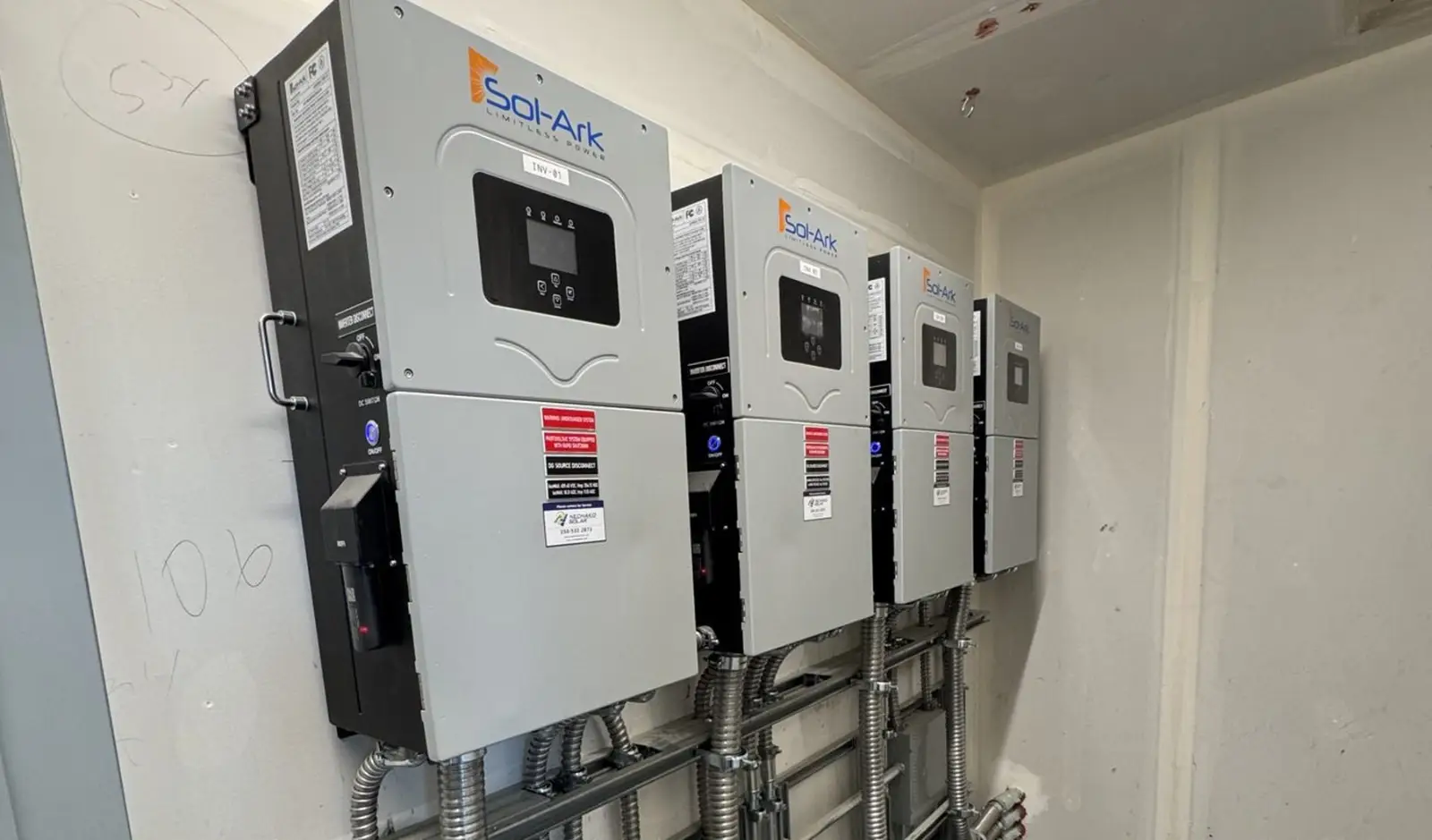
Few stretches of Highway 16 have as many off-grid and rural properties as the Lakes District, and the area has a long memory for what happens when the power goes out for more than a day. We install solar, battery storage and automatic back-up power here, start to finish, under our own electrical licence.
You can order equipment online and have it on a pallet in your yard next week. What is harder to find out here is the rest of it: the design that suits your actual loads, the permit, the licensed electrician to terminate it, the inspection, and the BC Hydro interconnection at the end.
That is the part we do. We are an electrical contractor that installs solar. The array, the battery, the panel work and the paperwork are one crew and one point of accountability, not a box of parts and a phone number.
Solar, battery bank and an automatic generator changeover, designed as one system for a property that was never going to be cheap to connect.
A battery that carries the essentials through an outage, without anyone starting a generator in a snowstorm.
Arenas, halls and shops draw hard during daylight hours, which is exactly when an array produces. Those are the buildings where the arithmetic works best.
Burns Lake sits at 755 metres — higher than Prince George, higher than Smithers — and yet the building code gives it the same ground snow load as Prince George, 3.4 kPa. That surprises people who assume elevation and snow load track together. They do not always.
What that means practically is that a Burns Lake roof is designed against much the same figure as one in town here, and a properly clamped, properly laid out array is well inside what a modern module handles. Modules are tested to 5,400 Pa on the face. The longer explanation of how snow loads become a roof layout is here.
The Southside is a different job. Properties across Francois Lake, and much of the country south of it, are genuinely remote — long service runs, long outages, and a ferry between you and the nearest line crew. That is where we stop talking about payback and start talking about whether the house stays warm without anyone doing anything. Off-grid and battery back-up are frequently the better build down there than a grid-tied array.
At 227 km we schedule Lakes District work in blocks rather than dropping in for an afternoon, which is why the site visit, the design, the BC Hydro application and the rebate paperwork all happen before the trailer gets loaded. The full sequence is written out here.
BC Hydro closed net metering to new customers on 1 July 2026. Under the Self-Generation rate that replaced it, the power you export is bought at 10 cents per kWh and credited on every bill rather than settled once a year.
Rebates are still on the table — up to $5,000 on solar and up to $5,000 on a battery enrolled in BC Hydro’s Peak Saver program, or up to $1,500 without it. But since 1 June 2026 BC Hydro only pays them when the work is done by a Home Performance Contractor Network member. We are one. If your installer is not, the rebate simply does not get paid.
Want a number before you call? The solar savings calculator uses our own pricing and your actual BC Hydro consumption to size a system and estimate the payback for a home in Burns Lake.
About 227 km west of Prince George on Highway 16, with Vanderhoof roughly halfway. We work along this corridor regularly, so a service call does not mean waiting for someone to come up from the coast.
Tell us about the property and what you need it to run. We will design around that.
Nechako Solar is a licensed BC electrical contractor, licence LEL0204111, and a member of the Home Performance Contractor Network (HPCN) — you can check that in the HPCN directory. Rebate amounts and rate details are current as of August 2026 and are set by BC Hydro, not by us.