
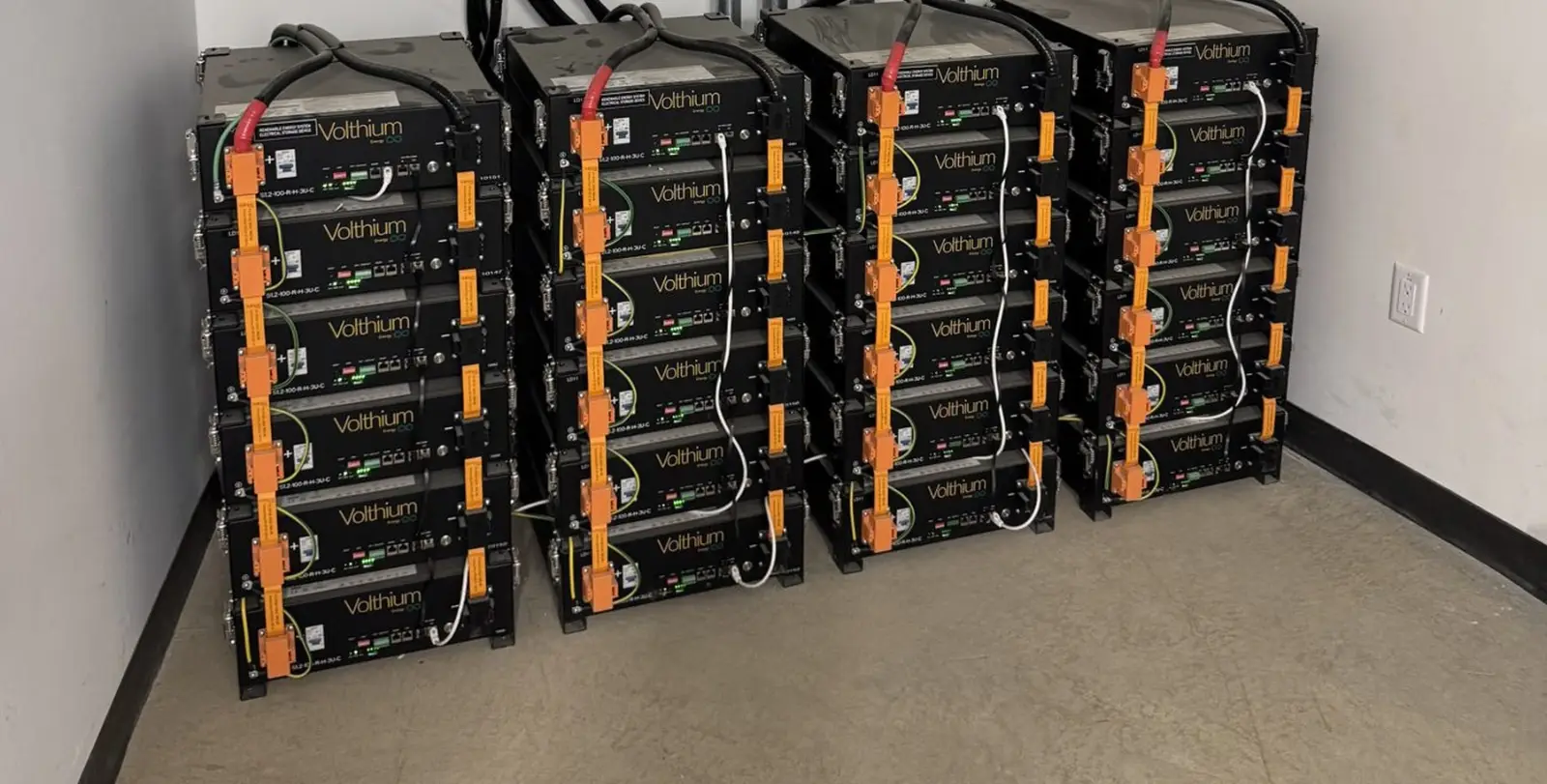
When the power goes out here it is rarely for ten minutes. A battery keeps the house running through it — no generator to start in the dark, no fuel to haul, nothing for you to do.
Long distribution lines, heavy timber, and weather that takes the power down and keeps it down. An outage in Prince George in February is not the same event as an outage in Vancouver in May — the furnace stops, the well pump stops, and if you are on an acreage the nearest line crew may be hours away.
Most people deal with that using a portable generator. It works, if someone is home, if it starts, and if there is fuel. A battery is the version that does not need anyone to do anything.
This catches almost everyone, including people who already have solar on the roof, and it is worth understanding before you decide whether you need a battery.
A grid-tied solar array is required to shut itself down the instant the grid goes down. That is not a fault and it is not a cheap inverter — it is a safety rule, and every legally connected grid-tied system in the province behaves this way. If arrays kept pushing power out onto the lines while a crew was up a pole restoring them, it would put that crew in danger. So the inverter senses the outage and disconnects itself in a fraction of a second.
Which means that on a bright clear February afternoon, with ten kilowatts of panels on your roof making nothing at all, your house is exactly as dark as your neighbour’s.
A battery is what changes that. It gives the system somewhere to send the power and a stable reference to run against, so the inverter can safely isolate your house from the grid and keep going on its own. Panels plus a battery carries the house and recharges through the day. Panels on their own do not carry anything.
How much of the house it carries is the next question, and the honest answer is less than most people picture.
Furnace fan, well pump, fridge and freezer, lights, internet and a few outlets. This is what most systems are sized for and it is what keeps a house liveable.
Including electric heat and the range. Possible, but it needs considerably more capacity and it costs accordingly. Usually not the right trade.
The battery carries the outage silently. If it runs low, a generator starts automatically, tops it up and shuts down again. This is what we build for properties where an outage genuinely cannot be allowed to win.
A home battery installed generally runs $12,000 to $20,000 depending on capacity, before rebates.
BC Hydro pays $500 per kWh on eligible batteries — up to $5,000 if the battery is enrolled in BC Hydro’s Peak Saver program, or up to $1,500 for an eligible battery paired with solar outside Peak Saver. Minimum system size is 5 kWh, and the rebate is capped at half the installed cost.
Only a limited set of battery models currently qualifies for the Peak Saver tier, and Tesla products are not eligible for the rebate at all. Worth confirming before you order rather than after. If the Peak Saver route is the one you want, BC Hydro requires the battery to be enrolled within 14 days of interconnection approval to get the higher amount. Miss that window and the claim drops to the lower tier, which on a residential job is a difference of thousands of dollars. We track that date as part of the job rather than leaving it with you.
On 1 July 2026 BC Hydro replaced net metering with the Self-Generation rate. Exported power is now bought at 10 cents per kWh rather than credited at the retail rate you pay.
That flips the arithmetic. Under the old rules, sending surplus to the grid was as good as using it. Now the power you use yourself is worth noticeably more than the power you export — and storing your afternoon surplus to use it in the evening is exactly what a battery does. More on the rate change here.
A battery installation is a service-panel job. It involves a critical-loads subpanel, an automatic transfer arrangement, and an inspection. It is electrical work with a battery attached, not a battery with some wiring attached.
We are a licensed BC electrical contractor. The design, the panel work, the permit, the inspection and the BC Hydro paperwork are one crew and one accountability.
Want to run your own numbers? Put your consumption through our savings calculator and see the size, the cost after rebate and the payback for your own property.
Wondering what actually happens after you say yes? Every step from the first phone call to switch-on is written out here — including the BC Hydro paperwork we handle for you.
Tell us what you want to keep running in an outage and roughly how long. That is enough for us to size it and give you a number.
Nechako Solar is a licensed BC electrical contractor, licence LEL0204111, and a member of the Home Performance Contractor Network (HPCN) — you can check that in the HPCN directory. Prices are indicative ranges and are not a quote. Rebate amounts and eligibility are set by BC Hydro and current as of August 2026.