
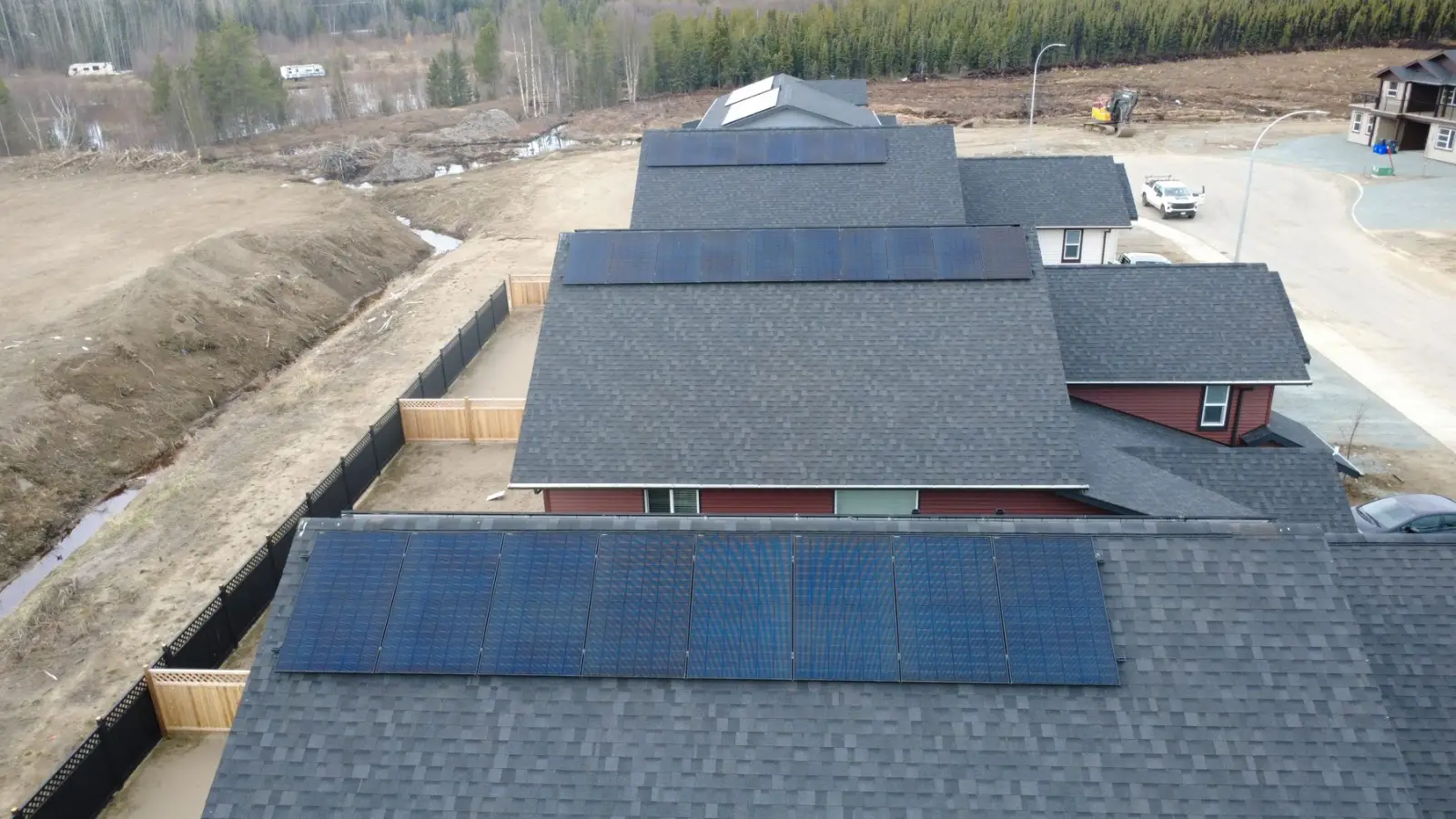
Does solar actually work in a Prince George winter?
It is the first question we get asked, and the honest answer has two halves. The cold is not the problem people think it is. The short days genuinely are. And a well-designed system is one that expects that.
Cold helps. Genuinely.
Solar panels are semiconductors, and semiconductors work better cold. A panel on a clear −15°C day in February is operating more efficiently than the same panel on a hot afternoon in July. The limiting factor in a Prince George winter is not temperature at all. It is how many hours the sun is above the horizon, and how low it sits.
Where the year’s production actually falls
Around Prince George, modelled output at the optimum tilt is about 1,250 kWh per kW installed per year. A real roof at a typical pitch and orientation gives up some of that, so we plan on roughly 1,100 kWh per kW and treat anything above it as upside. Either way it is a usable number. Comparable to plenty of places that think of themselves as sunny.
But it does not arrive evenly. On the modelled figures, roughly half the year’s production lands between May and August, and well under a fifth of it between November and February. December is the low point by a wide margin.
What that means in practice: solar in Northern BC overproduces in summer and underproduces in winter. Under the old net metering rules you banked the difference. Under the Self-Generation rate that replaced it in July 2026, exported power earns 10 cents per kWh credited each month instead. Either way, the winter shortfall is expected. Not a fault.
What about the snow?
Less than people assume. A five-year study by NAIT in Edmonton measured annual production losses from snow cover at around 3%. Against the 20% the industry had been assuming. What mattered more than snowfall was the angle: roughly 45° performed best, while a vertical wall mount lost 24%.
Edmonton is not Prince George, and we would not pretend the two are identical. But the direction is clear: snow is a minor annual loss, not a season-long shutdown. Panels are dark, they are smooth, and they are usually the first thing on a roof to clear. Snow loads, drift zones, snow guards and when a ground mount beats a roof.
The design that suits a northern winter
- Tilt matters more here. There is a sweet spot. Steep enough to catch the low winter sun and shed snow, without giving away summer production. It is worth getting right rather than defaulting to the roof pitch.
- Shade audits matter more here. A low winter sun means trees and rooflines cast far longer shadows than they do in June.
- Batteries need to be warm. Cold helps panels and hurts batteries. Where a system includes storage, where the bank lives is a design decision, not an afterthought.
None of this is exotic. It is simply what you get when the person designing the system has spent winters here.
Want the number for your roof?
We will model your actual roof, pitch and shading rather than quoting a regional average.
Nechako Solar is a licensed BC electrical contractor, licence LEL0204111, and a member of the Home Performance Contractor Network (HPCN). You can check that in the HPCN directory. Rebate amounts and rate details are current as of August 2026 and are set by BC Hydro, not by us.